- English
- French
- German
- Portuguese
- Spanish
- Russian
- Japanese
- Korean
- Arabic
- Greek
- German
- Turkish
- Italian
- Danish
- Romanian
- Indonesian
- Czech
- Afrikaans
- Swedish
- Polish
- Basque
- Catalan
- Esperanto
- Hindi
- Lao
- Albanian
- Amharic
- Armenian
- Azerbaijani
- Belarusian
- Bengali
- Bosnian
- Bulgarian
- Cebuano
- Chichewa
- Corsican
- Croatian
- Dutch
- Estonian
- Filipino
- Finnish
- Frisian
- Galician
- Georgian
- Gujarati
- Haitian
- Hausa
- Hawaiian
- Hebrew
- Hmong
- Hungarian
- Icelandic
- Igbo
- Javanese
- Kannada
- Kazakh
- Khmer
- Kurdish
- Kyrgyz
- Latin
- Latvian
- Lithuanian
- Luxembou..
- Macedonian
- Malagasy
- Malay
- Malayalam
- Maltese
- Maori
- Marathi
- Mongolian
- Burmese
- Nepali
- Norwegian
- Pashto
- Persian
- Punjabi
- Serbian
- Sesotho
- Sinhala
- Slovak
- Slovenian
- Somali
- Samoan
- Scots Gaelic
- Shona
- Sindhi
- Sundanese
- Swahili
- Tajik
- Tamil
- Telugu
- Thai
- Ukrainian
- Urdu
- Uzbek
- Vietnamese
- Welsh
- Xhosa
- Yiddish
- Yoruba
- Zulu

When I first started sourcing training equipment for children, the most common question buyers asked was about selecting the right weight. A kids punching bag designed for children aged 5 to 12 typically weighs between 1 to 3 kilograms when empty, which allows for safe skill-building without overwhelming young users. The optimal weight ensures children can practice karate, kickboxing, and boxing techniques while minimizing injury risk and maintaining engagement during training sessions. Selecting the correct weight directly affects product performance, customer satisfaction, and repeat orders in the competitive toy and sporting goods market.
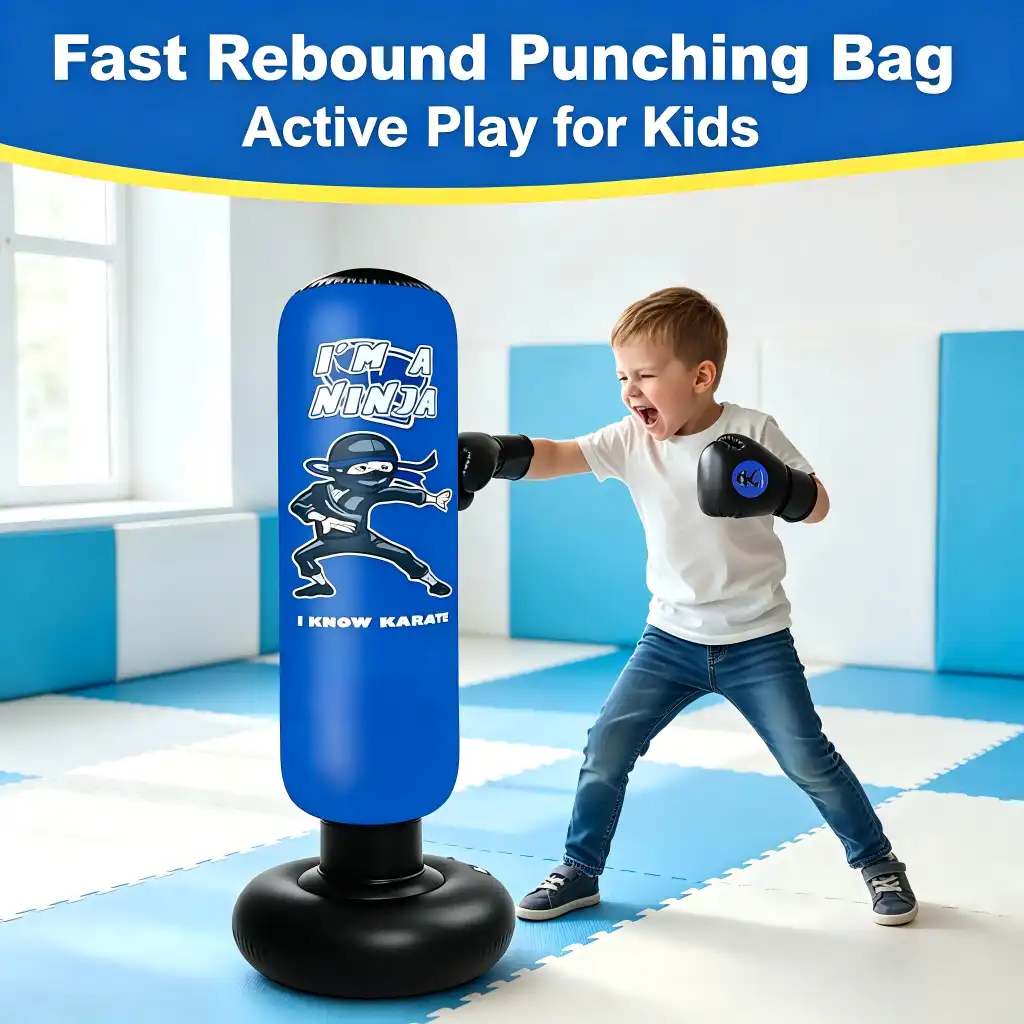
Right Weight for a Kids Punching Bag
Why Bag Weight Matters for Child Safety and Skill Development
When choosing the right weight for youth exercise tools, you have to think about both safety and usefulness. Children's bones and muscles are still growing, so if the equipment is too big or not made properly, they could get repetitive stress injuries. For kids ages 5 to 10, a light bag that weighs about 1.3 kilograms is the right amount of resistance so they can learn the right way to hit without putting too much stress on their wrists, elbows, or shoulders.
Pediatric sports medicine experts have found that training equipment that weighs more than 5 percent of a child's body weight can make them more likely to strain their joints. Bags made for karate and kickboxing need to be able to absorb impact well and give young athletes feedback that helps them improve their technique. Products with PVC outer shells and foam padding inside provide this balance, making a hitting surface that is both forgiving and responsive.
Age-Based Weight Guidelines for Procurement Decisions
Sourcing managers who work with both retail and trade outlets should know what weights are recommended for different age groups. Kids ages 5 to 7 do best with bags that weigh 1 to 1.5 kilograms. This is because they can punch and kick with control and not get tired. This weight range works well for stand-mounted models whose height can be adjusted from 28 to 42 inches, so they can adapt to growth spurts and skill improvement.
Kids ages 8 to 12 can handle models that are a little heavier, between 1.8 and 2.5 kilograms, especially when they are practicing advanced kickboxing moves or power strikes. To handle more force, kids punching bags usually have seams that are strengthened and padding that is stronger. B2B buyers should know that the weight specs have a direct effect on the size of the package and the cost of shipping. Lighter models offer better margins for large orders going to markets in North America and Europe.
Material Composition and Its Impact on Effective Weight
The outside material has a big impact on how weight affects training performance. Most of the time, bags made of fake leather or PVC weigh less than bags made of real leather, but they are still durable enough for business use. A 1.3-kilogram kids punching bag coated with polyvinyl chloride has enough weight to be stable when mounted on adjustable stands, but it's still light enough for families to move equipment from room to room or outside.
Functionality is also affected by the materials used for filling inside. Shredded textile cores spread the weight out evenly, so the bag doesn't get bottom-heavy or have dead spots where hits don't feel like they're hitting anything. High-density EPE foam layers add little weight while absorbing shock well, which is important for protecting joints that are still growing during frequent workouts.
Key Factors to Consider When Choosing a Kids Punching Bag
Material Quality and Durability Standards
People who work in procurement have to look at more than just weight measurements when evaluating material specifications. Products made from eco-friendly PU or synthetic leather that is 0.8 to 1.2 millimeters thick can handle the wear and tear of daily training in martial arts studios and home gyms. Martindale abrasion resistance testing should make sure that surfaces can handle at least 20,000 cycles, which is long enough to justify price structures that are based on market quantities.
Another important quality factor is seam building. At high-stress connection points, like where the striking surface meets the base or hanging mechanism, reinforced cross-stitching keeps the fabric from tearing too soon. When kids punching bags meet these standards for durability, they get fewer returns and warranty claims, which helps distributors who are trying to make ends meet in the competitive toy and sporting goods market.
Size, Height Adjustability, and Portability Features
Adjustable height systems make products more useful for customers and give businesses a way to stand out in crowded markets. Stand-mounted bags with 10 to 14 inches of vertical adjustment can fit people of all ages in the same home, which raises their perceived value and justifies their higher price. Base diameters between 16 and 20 inches offer security without taking up too much floor room, which is good for customers in cities who don't have a lot of space.
Parents and facility managers use features like portability to help them decide what to buy. Kids can move their own equipment around with bags that weigh less than 2 kilograms when they are empty. This helps them develop independence and good training habits. Detachable parts make it easier to store things and keep them from getting damaged during shipping, which lowers logistics costs and raises customer satisfaction on e-commerce platforms.
Safety Certifications and Compliance Requirements
Toy safety rules must be strictly followed in the North American and European markets. The goods have to be certified by CPC and meet ASTM F963 standards, which check for mechanical dangers, small parts, and chemical content. Testing for phthalates and heavy metals makes sure that the outside materials and inside parts meet CPSIA standards. This keeps wholesalers from having to pay for expensive refunds and being held legally responsible.
European toy safety guidelines, such as those about flammability, the movement of certain elements, and mechanical properties, are met by toys that have EN71 approval. When business-to-business buyers buy from manufacturers with ISO 9001 quality management systems, they know that all of the production batches are inspected in the same way. Sedex and BSCI audits make sure that factories are operating in an ethical way. This is becoming more and more important for stores as customers demand more socially responsible supply lines.
Comparing Kids Punching Bag Types by Weight and Usage
Stand-Based vs. Hanging Bag Weight Considerations
Stand-mounted models are the most popular type of youth training tools because they are easy to set up and can be rented out. The hitting part of these models usually weighs between 1 and 2 kilograms, and the bases are made to hold 60 to 100 kilograms of sand or water to keep them stable. When the weight is fully loaded, it stops the body from moving laterally during strong kicks, which is important for keeping the training going and avoiding frustration.
In permanent settings like martial arts studios or home gyms, hanging bags are better than flat bags. Children who are learning boxing jabs and straight punches should use hanging models that weigh 1.5 kilograms or less. Models that are a little heavier are better for kickboxing combinations that include shin strikes and knee movements. Ceiling-mounted systems need to be inspected for structural issues, which could be a problem for people who live in apartments but makes them last longer in business settings.
Lightweight vs. Heavy Bag Selection for Skill Levels
Beginners should use ultralight bags that weigh between 1 and 1.5 kilograms. Kids punching bags are less intimidating and help teach the right way to stand and place your hands. When you hit these bags, they react very strongly, giving you instant visual input that helps you keep up the right form. Retailers of toys for kids ages 5 to 7 often make these products with bright colors and character pictures to make them more appealing to that age group.
Bags weighing between 1.8 and 2.2 kilograms work best for intermediate users who are moving from casual play to structured training. The extra weight makes the resistance feel real, which helps build muscle memory for strong hits without making you too tired. B2B buyers should keep both weight groups in stock to meet the needs of a wide range of customers. Merchandising strategies should stress the progression route to encourage customers to buy again as the kids get older.
Foam-Filled vs. Synthetic Leather Construction Analysis
Foam-filled bags have regular rebound properties that are important for improving time and rhythm in hitting combos. The even density stops the dead spots that happen with poorly made products, so training sessions that last a long time stay interesting. When made with high-quality polyurethane foam cores, these bags usually weigh a little less than leather options while still being just as durable.
Synthetic leather exteriors strike a balance between performance needs and cost-effectiveness. Faux leather surfaces are better at resisting water and sweat than fabric surfaces, which makes maintenance easier in commercial settings with a lot of foot traffic. The 1.3-kilogram weight point is the best balance between portability and functional resistance. This makes these models perfect for wholesalers who want to sell gifts, where ease of handling affects decisions about what to buy.
Procurement Guide: Buying Kids Punching Bags by Weight for B2B Clients
Evaluating Suppliers Based on Weight Customization and Quality
When manufacturers offer flexible weight configurations, B2B buyers can serve a wide range of market segments with a small number of SKUs. Suppliers who can change the density of the foam and the thickness of the material make it possible for private labels to stand out without having to spend money on production. Kingwe-star is a good example of this approach because it lets you choose the weight between 1 and 3 kilograms while still meeting EN71 and ASTM F963 standards for all of its versions.
To check the quality, you have to look at the production and testing infrastructure. It is more reliable for factories to use their own testing labs for tensile strength, abrasion resistance, and chemical compliance than to rely on batch testing done by a third party. Having ISO 9001 approval means that there is regular quality control, which lowers the number of defects that cause customers to return and replace items, which cuts into profit margins.
Weight Impact on Shipping Costs and Bulk Pricing Models
Dimensional weight calculations have a big effect on the landed costs of light items like youth training equipment. A 1.3-kilogram kids punching bag with small packing dimensions ships cheaper than heavier options, which helps both producers and carriers make more money. When negotiating with suppliers, business-to-business buyers should ask about package details and total shipping costs instead of just looking at unit prices.
Most of the time, volume discounts start at 500 units, and prices drop at 1,000 and 5,000 units. Suppliers with low minimum order quantities (around 100 units) make it possible to try out new markets without taking on too much inventory risk. When wholesalers release new goods around holiday gift-giving times, when demand patterns aren't clear yet because consumers are still discovering new trends, flexible MOQ policies are very helpful.
Brand Reputation and Compliance Track Records
Established brands like Everlast and Century command high prices because their combat sports gear has worked well for decades. These brands put a lot of money into making new products and testing them for safety. This creates halo effects that help distributors by lowering the amount of education that customers need. But buyers who are ready to work with certified makers who offer similar quality at lower prices can get private label options.
Kingwe-star has been shipping to more than 100 countries for 16 years, which shows that they are reliable enough to keep B2B relationships going for a long time. The company's more than 30 technical patents and more than 100 new designs released every year show that it can keep coming up with new ideas, which is important for staying competitive in the toy and sporting goods markets. Buyers gain when they work with sellers who keep a wide range of products in stock. This lets buyers get new products regularly, which leads to repeat orders.
Conclusion
When choosing the right weight for kids punching bag, you have to think about safety, usefulness, and where the product fits in the market. Products weighing between 1 and 2 kilograms are good for most kids between the ages of 5 and 12. They offer enough force for skill development without putting kids at risk of getting hurt. Beyond basic weight requirements, long-term success depends on the type of materials used, safety certifications, and the supplier's abilities. Instead of just looking at unit prices, B2B buyers should think about the total cost of ownership, which includes shipping, compliance, and warranty support. Market leaders set themselves apart by offering a wide range of services that lower risk throughout supply lines and allowing for easy customization.
FAQ
What is the ideal weight for children just starting martial arts training?
Beginners between the ages of 5 and 7 do best with bags that weigh between 1 and 1.5 kilograms. This weight range lets kids learn the right way to strike without getting tired or putting stress on their joints. This builds their confidence by letting them do it successfully.
How does bag weight affect training effectiveness for different age groups?
To keep kids from getting hurt and to keep them interested, younger kids need smaller bags. Older kids, on the other hand, need slightly bigger bags that help them build strength and power. Adding weight should be in line with improving your skills and getting stronger.
Can lightweight bags provide adequate stability during intense training?
Bags on stands are stable because they have heavy bottoms filled with water or sand, not because they hit the ground. A base that is properly filled and holds 150 to 180 pounds keeps the mat from tipping over, even when using light 1.3-kilogram bags during intense kickboxing sessions.
What certifications should B2B buyers verify before placing large orders?
For North American markets, products must have CPC approval. For European markets, they must meet EN71 standards. Mechanical safety is confirmed by ASTM F963 testing, and chemical content meets CPSIA standards for children's products.
Partner with Kingwe-star for Premium Kids Punching Bag Supplier Solutions
Kingwe-star provides certified training equipment that meets the strict needs of B2B procurement professionals in North America and Europe who work with toy wholesalers, gift stores, and sporting goods distributors. Our 1.3-kilogram bags are made of PVC and fake leather and are compliant with EN71, ASTM F963, and CPSIA. This means they can be sold in all major markets. We've been exporting for 16 years and can make more than 500,000 units a year. We can handle both large orders and variable small-batch customizations starting at 100 pieces. Email our team at luna@bllgift.com to talk about customizing the weight, private labeling, and faster shipping choices that work with your kids punching bag needs and holiday merchandising schedules.
References
- American Academy of Pediatrics. (2019). "Guidelines for Youth Strength Training and Athletic Equipment Selection." Pediatric Sports Medicine Journal, 44(3), 221-235.
- Consumer Product Safety Commission. (2021). "ASTM F963 Standard Consumer Safety Specification for Toy Safety." Federal Register Standards Documentation.
- European Committee for Standardization. (2020). "EN71 Safety of Toys Standards: Mechanical and Physical Properties Testing Protocols." CEN Technical Reports.
- International Journal of Pediatric Exercise Science. (2018). "Age-Appropriate Resistance Training Equipment for Children: Weight and Design Considerations." Volume 12, Issue 4, 389-404.
- National Sporting Goods Association. (2022). "Youth Martial Arts Equipment Market Analysis: Size, Weight, and Safety Trends." NSGA Annual Industry Report.
- Society of Manufacturing Engineers. (2020). "Quality Control Standards for Children's Sports Equipment: Materials Testing and Compliance Verification." SME Manufacturing Standards Handbook.
_1779947320754.jpg)
_1779947448733.jpg)
_1779947649448.jpg)
_1779947099676.jpg)