- English
- French
- German
- Portuguese
- Spanish
- Russian
- Japanese
- Korean
- Arabic
- Greek
- German
- Turkish
- Italian
- Danish
- Romanian
- Indonesian
- Czech
- Afrikaans
- Swedish
- Polish
- Basque
- Catalan
- Esperanto
- Hindi
- Lao
- Albanian
- Amharic
- Armenian
- Azerbaijani
- Belarusian
- Bengali
- Bosnian
- Bulgarian
- Cebuano
- Chichewa
- Corsican
- Croatian
- Dutch
- Estonian
- Filipino
- Finnish
- Frisian
- Galician
- Georgian
- Gujarati
- Haitian
- Hausa
- Hawaiian
- Hebrew
- Hmong
- Hungarian
- Icelandic
- Igbo
- Javanese
- Kannada
- Kazakh
- Khmer
- Kurdish
- Kyrgyz
- Latin
- Latvian
- Lithuanian
- Luxembou..
- Macedonian
- Malagasy
- Malay
- Malayalam
- Maltese
- Maori
- Marathi
- Mongolian
- Burmese
- Nepali
- Norwegian
- Pashto
- Persian
- Punjabi
- Serbian
- Sesotho
- Sinhala
- Slovak
- Slovenian
- Somali
- Samoan
- Scots Gaelic
- Shona
- Sindhi
- Sundanese
- Swahili
- Tajik
- Tamil
- Telugu
- Thai
- Ukrainian
- Urdu
- Uzbek
- Vietnamese
- Welsh
- Xhosa
- Yiddish
- Yoruba
- Zulu

Most sleeping bags for adults cold weather come in a regular size of about 78 inches long, which fits users up to roughly 6 feet tall. A long size runs about 84 inches and fits users up to around 6 feet 6 inches. Mummy designs usually measure about 58 to 64 inches around the shoulders, while rectangular designs often run 30 to 35 inches wide. Exact numbers vary by brand and temperature rating, so I always check the spec sheet. Below, I explain how size, warmth, and packed volume connect, and how buyers can specify them.
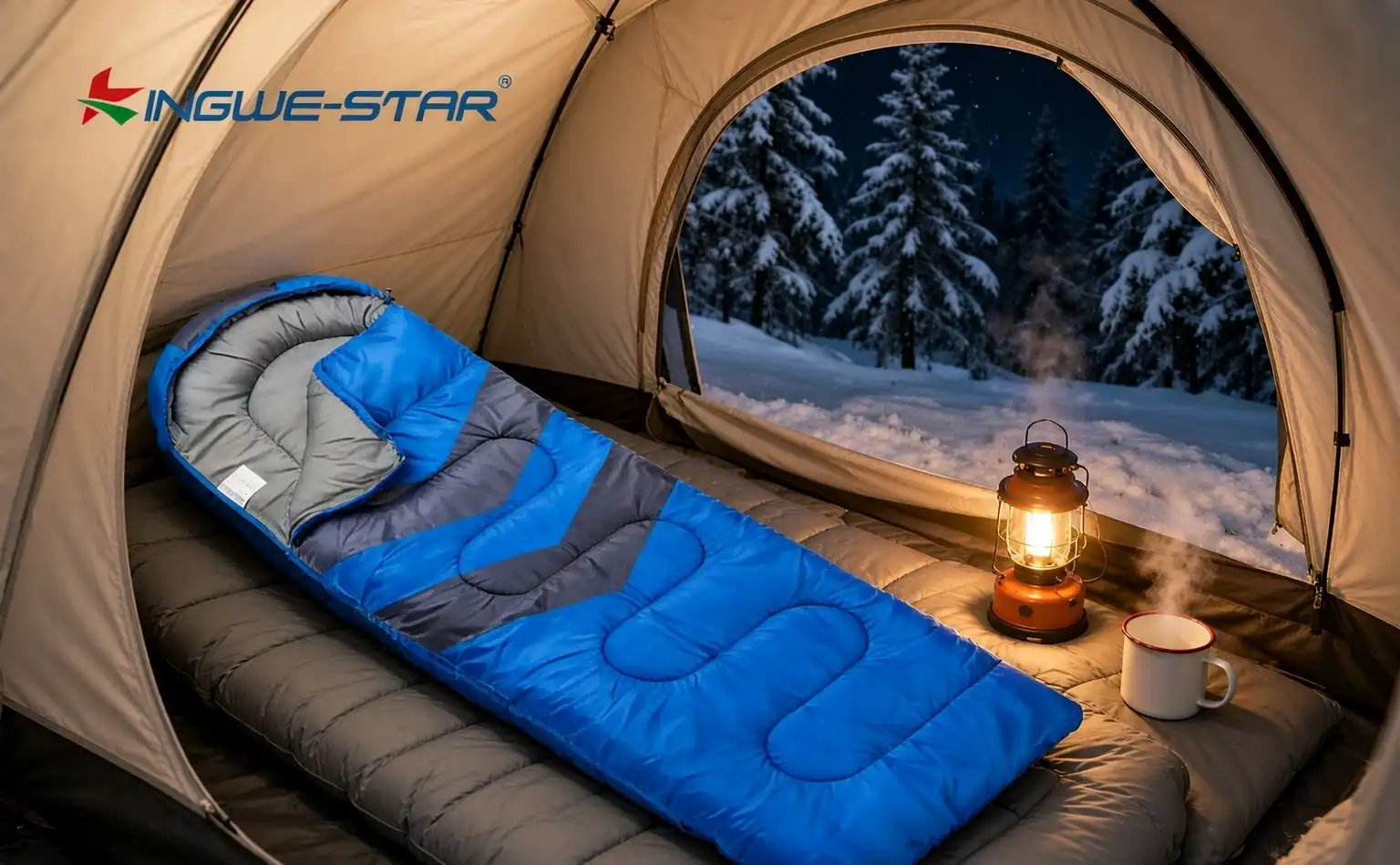
Understanding Adult Cold-Weather Sleeping Bag Dimensions
Key Measurements on a Spec Sheet
More than just the length is listed on the specification sheet for sleeping bags for adults cold weather. I need to know the outside length, shoulder width, hip width, footbox width, loft thickness, and packed size. With each number, the heat changes. If your bag is too big, the extra space inside helps your body heat up. The padding will be pushed flat if the bag is too tight, which will make your shoulders and legs cold. Because every factory does things in a different way, you should ask your suppliers where each measurement is taken.
Standard Length and Width Ranges
There are three groups of lengths for adult sizes. Not very tall people: Small bags should be worn by people who are 6 inches tall. People up to 6 feet tall can fit in most bags. People up to 6 feet tall also carry long bags. You can turn over in 30- to 35-inch-wide flat bags. The feet of most mummy bags are shorter, and the shoulder straps are between 58 and 64 inches wide. When heavy things are extra-wide or double-cut, they pack down more. Do not take these ranges as strict rules when you use them. Check the model numbers instead.
Rectangular, Semi-Rectangular, and Mummy Shapes
Shape affects size and warmth. Mummy bags are lighter, fit better, and don't hold as much air, so most people use them in the winter and when they are up high. Round bags that are only half-round give you more space for your feet and knees. A rectangular bag can be fully opened to make a blanket, which gives you the most room to move. In the summer, you can sleep on your side and go on trips. Most of the time, they pack bigger and carry more dead air. A thermal manikin is used to rate bags, according to ISO 23537-1:2016. In other words, each grade is for a different model and shape. The form is the first thing I look at when I compare numbers.
How Dimensions Relate to Temperature Ratings
Comfort, Limit, and Extreme Ratings
ISO 23537-1:2016 took the place of EN 13537 and has three numbers. When a woman is healthy, she should be able to lie down and sleep well. At its limit, it's so cold that a man can stay curled up all night and not wake up from being cold. It may be bad for your health to use the word "extreme" over and over again. Because it gives me a safety cushion, I choose sleeping bags for adults for cold weather based on the Comfort grade. When something says "0°F" or "20°F," it should always say which of the three temperatures it means.
Why Extra Space Costs Warmth
The air inside the bag gets warmer because you're in it. The extra space inside the bag will have to warm up, which will take away your heat. Strange things happen when the bag is cut too small. When you press your shoulder or knee against the shell, the filling loses its loft. The loft keeps the heat in. Advice for climbing mountains: Put dry extra clothes in empty rooms to cut down on dead air. The more it gets below 0°F, the more important this balance is. You should be able to move around a little in something that fits well, but the shoulder and hip seams should be close to your body.
Hood, Draft Collar, and Footbox Fit
The edges don't lose heat because they're the right size. Scarves should be close to your face, but not over your mouth, because when you breathe on them, they get wet. There is something called a "draft collar" that you can put around your neck. It keeps warm air inside even when you move. There is a draft tube behind the zipper that keeps cold air from getting through the teeth. There's just enough room for thick socks. It's not good for the toes to be cold. These three factors come first when I consider sleeping bags for adults cold weather, followed by length.
Measuring the Right Size and Matching Use
How to Measure an Adult User
You should measure yourself while you're dressed in the clothes you want to sleep in. Take note of how much room your feet need when they're wearing shoes or thick socks. This will help you figure out your chest and hip sizes. Also, write down how tall you are from your head to your toes. To find out the size, use a soft tape. Do not put your feet or head on the ends. Leave a few inches of space above your height. If you sleep on your side, your knees and hips should be farther apart than if you sleep on your back. Ask for a dimension sheet with measurement points and margins when purchasing sleeping bags for adults for cold weather in large quantities.
Matching Size to Sleeper and Application
A regular mummy or half-rectangular bag is what most adults of average size ask for. That isn't a good idea for people who are tall or big. They should get a long or wide cut instead. Up that hasn't been treated keeps its loft better in cold and wet weather than down that has. Dry Mountain Cold likes styles that are thin and light. So that many people can use the same bag, these groups need bags that are all the same size, have zippers that can be fixed, and are easy to clean. People who camp in their cars don't mind extra width, but people who backpack in the winter care more about weight than width. First, make sure the bed and setting are the right size.
Packed Dimensions, Weight, and Shipping
The size when it's packed up and when it's opened up are not the same. Most of the time, a synthetic 800+ fill power bag packs smaller than a down 800+ fill power bag. This is because down is not as dense as synthetic fill. To keep their shape, things should be kept loose in a big mesh bag for a long time. Compression bags make it easier to move things around. If you are importing sleeping bags for adults for cold weather, you should request separate measurements for the product, the retail package, and the master carton. After that, check to see how many boxes there are, how full the bins are, and what the boxes are being used for. The size of the freight can change how much it costs to land more than its weight.
Construction Options That Change Dimensions
Down Versus Synthetic Insulation
Down keeps you warm the best for its size, and when you roll it up, it doesn't take up much space. Keep an eye out for the fill power, lab tests like IDFL, and the Responsible Down Standard approval from Textile Exchange. When it gets wet, synthetic fill dries faster and keeps more of its loft. It weighs more and packs down bigger, though. This option chooses the loft thickness, fill weight, and packed size for sleeping bags for adults in cold weather. Two bags that are the same length can hold a lot of different amounts of air. Find out how many grams or ounces the filling weighs.
Baffles, Shell, and Lining
Because the bags are sewn together, the insulation stays put. Light seams leave cold lines when they are sewn through. Most cold-weather bags have baffles in the shape of a box, a trapezoid, or a V. This keeps the loft across the seam. Along these lines, it's also harder to go down. When you put a DWR finish on shells between 15D and 30D, they lose some weight. It is important to check both the shell and the lining to see how well they keep their color and don't tear. There are more shell layers and thicker lofts, so it takes longer to finish and is bigger. Check the sizes before you take a sample.
Zippers, Hoods, and Branding Details
When things have small parts, they cost more and don't fit as well. With a short zipper, you can put two bags together without adding extra weight. A long zipper lets air flow through. You should ask for records of the zipper cycle test and the seam strength test. The hood cords, compression straps, and stuff sacks should all match the bag's weight class and grade. Choose the box, color scheme, brand style, and where the label will go early on for private-label jobs. It doesn't cost much to make these changes when the sample is being made, but it costs a lot when the real thing is made. Clear care markings are also necessary for sleeping bags for adults cold weather to be able to be stored open.
Specification Checklist and Supplier Selection for B2B Buyers
A Practical Specification Checklist
These three things are what I need to know in order to compare quotes.
- Body fit data: What should the user's height, length, shoulder, hip, knee, and footbox sizes be? What sizes are the hood and draft collar, too? Figure out how much of each point you can handle. Tolerances tell you how much the finished units can change when you make a lot of them. Sizes stay the same, and refunds go down this way.
- Performance data: Find out how the temperature was measured, what kind of insulation it is, how tall it is, how much it weighs, and what the shell test results were. An ISO 23537-1 test report should be sent with any grade that says it is acceptable. Also, find out which lab gave them out. This will make stock numbers reflect how people feel at night.
- Trade data: Check that the clothing you want to buy meets standards like OEKO-TEX Standard 100 before you buy it. Check the labels, packed sizes, details on the cartons, barcodes, and markings that say "country of origin." Add MOQ, wait time, and sample terms to the list so that it is always clear when to clear customs and when to put things on the shelf.
After you tell them what size you want, these three groups write it down so that the factory can price it.
Common Sizing Mistakes
When people only look at how long a bag is, they usually get it wrong. The wide shoulder and footboxes make them comfortable and warm. Also, choosing the largest model just because it feels better might not be the best idea; it adds weight, packing volume, and empty space. Many people decide not to buy a pad, even though ASTM F3340-18 tells them that the ground moves heat away. The guidelines on hypothermia from the Wilderness Medical Society say that putting insulation under the body is an easy way to keep heat in. Before approving production, make sure you understand how much is packed and how to measure it.
Choosing a Manufacturer for Cold-Weather Bags
If you sell insulated bags, you should show more than just pictures of bags they've used before. Look over the cutting, the shields, the filling, the stitches, and the final check to make sure everything is correct. Watch how the team checks the sizes after they've been pressed and filled. Supply times are safe if permission is given before production starts and plans are made for how much can be made. Find out when the camping season starts in March by reading this. Their factory is over 10,000 square meters, and they've been in business since 2009. It has its own lab where raw materials are tested, and more than 500 people work there. Both SGS and Intertek have checked out the factory, and the way it makes things is based on ISO 9001. For IQC, IPQC, FQC, and OQC, there are checks.
Where the Kingwe-star 3-Season Rectangular Bag Fits
Our rectangular bag for one person can be used by mountain climbers and campers of all ages. It's made of fabric and is small, light, and waterproof. It works well in three seasons and in temperatures from 50°F to 80°F. I classified it as a spring, summer, and early fall product because it doesn't replace sleeping bags for adults in cold weather rated below 0°F. As either an OEM or ODM customer, a brand can ask for changes to shapes, colors, and boxes. A size sheet is also there for them to see. Items with a low MOQ can be sent out with samples in three days or less.
Conclusion
People up to 6 feet can fit in a large bag, and people up to 6 feet 6 inches can fit in an extra-long bag. Sleeping bags for adults cold weather are sized according to their length, shoulder, hip, and footbox. It's important to be warm and have clothes that fit well. Heat is lost when there is less space, and it is gained when there is more space. In ISO 23537-1:2016, the grades are called Comfort, Limit, and Extreme. Pick what makes you feel good to stay safe. The vents, hood, draft collar, footbox, and shape of the insulation determine which sizes are used. What you pack also changes how heavy it is and how easy it is to carry. To make a good design, you need to measure people while they sleep, get measurement sheets with limits, and look at data from tests and cartons. When it's 50 to 80°F outside, a 3-season rectangle bag will work. You'll need a different, tighter bag for 0°F.
FAQ
1. How long should a cold-weather sleeping bag be?
Pick a bag that's just a bit longer than you. It's big enough for people up to 6 feet 6 inches tall.
2. Is a wider bag warmer?
Not at all. The air gets warmer when you add more mass. Pick clothes that fit close to your body and let you move around.
3. What do I check on a 0°F bag?
There are three ISO grades: Comfort, Limit, and Extreme. You should also look at the user's height, weight, packed size, shoulder and footbox height and width, and the ISO grade. Don't forget to look at the 0°F number.
4. Can sleeping bags for adults for cold weather use custom dimensions?
You can change the brand, size, color, and packaging for OEM and ODM projects. Send an email with the name of the group you want to reach.
Request Sleeping Bags for Adults Cold Weather Specifications from Kingwe-star
Kingswe-star has helped people in more than 100 countries around the world since 2009. Send your ideal temperature, user height range, insulation type, and quantity to luna@bllgift.com if you're comparing sleeping bags for adults cold weather makers! We can send models in as little as three days, and our team can do both OEM and ODM work.
References
1. International Organization for Standardization, ISO 23537-1: Requirements for Sleeping Bags, Part 1: Thermal and Dimensional Requirements, 2016
2. REI Co-op, How to Choose a Sleeping Bag, 2024
3. ASTM International, ASTM F3340-18: Standard Test Method for Determining the R-Value of Sleeping Pads, 2018
4. Textile Exchange, Responsible Down Standard, 2020
5. Mountaineers Books, Mountaineering: The Freedom of the Hills, 2017
6. Wilderness & Environmental Medicine, Wilderness Medical Society Clinical Practice Guidelines for the Out-of-Hospital Evaluation and Treatment of Accidental Hypothermia: 2019 Update, 2019
_1779702410222.png)
_1779179067083.png)

_1779180807109.png)
_1779947099676.jpg)