- English
- French
- German
- Portuguese
- Spanish
- Russian
- Japanese
- Korean
- Arabic
- Greek
- German
- Turkish
- Italian
- Danish
- Romanian
- Indonesian
- Czech
- Afrikaans
- Swedish
- Polish
- Basque
- Catalan
- Esperanto
- Hindi
- Lao
- Albanian
- Amharic
- Armenian
- Azerbaijani
- Belarusian
- Bengali
- Bosnian
- Bulgarian
- Cebuano
- Chichewa
- Corsican
- Croatian
- Dutch
- Estonian
- Filipino
- Finnish
- Frisian
- Galician
- Georgian
- Gujarati
- Haitian
- Hausa
- Hawaiian
- Hebrew
- Hmong
- Hungarian
- Icelandic
- Igbo
- Javanese
- Kannada
- Kazakh
- Khmer
- Kurdish
- Kyrgyz
- Latin
- Latvian
- Lithuanian
- Luxembou..
- Macedonian
- Malagasy
- Malay
- Malayalam
- Maltese
- Maori
- Marathi
- Mongolian
- Burmese
- Nepali
- Norwegian
- Pashto
- Persian
- Punjabi
- Serbian
- Sesotho
- Sinhala
- Slovak
- Slovenian
- Somali
- Samoan
- Scots Gaelic
- Shona
- Sindhi
- Sundanese
- Swahili
- Tajik
- Tamil
- Telugu
- Thai
- Ukrainian
- Urdu
- Uzbek
- Vietnamese
- Welsh
- Xhosa
- Yiddish
- Yoruba
- Zulu

Making airplane launcher toys involves designing a spring-loaded or electric catapult mechanism that propels lightweight EPP foam gliders into the air at a consistent angle and velocity. The process covers material selection, mechanical engineering of the trigger system, aerodynamic glider shaping, and multi-stage quality control. For B2B buyers sourcing airplane toys, understanding this manufacturing process helps you ask the right questions, evaluate suppliers accurately, and select products that meet safety certifications like ASTM F963 and EN71 for the US and European markets.
Core Mechanics of Airplane Launcher Toys
I always tell teams that buy things that they should understand how these things work before they buy a lot of them. After reading that, you can decide which product specs are the most important.
How Launch Mechanisms Store and Release Energy
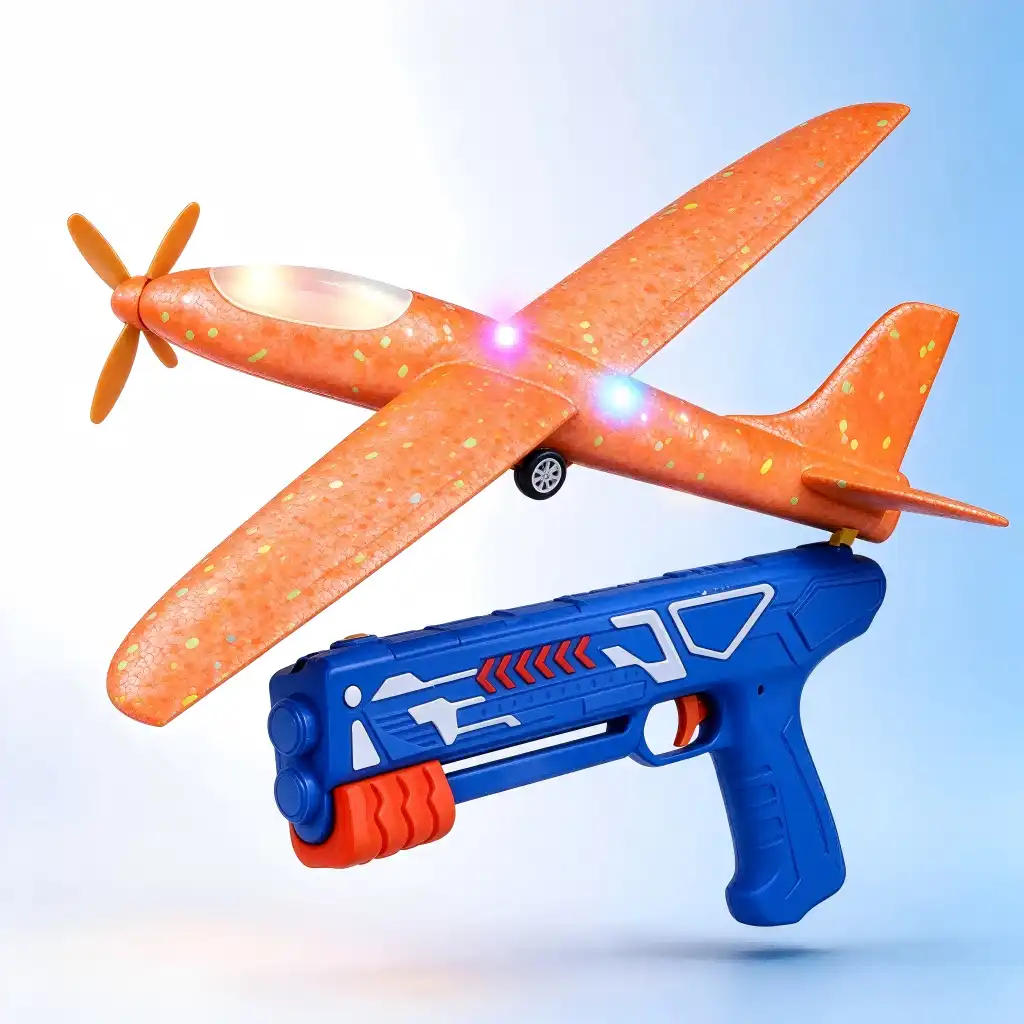
Plane missile toys store mechanical energy and send them through a squished spring or a stretched-out rubber part. The glider moves along a guide rail at a controlled speed as soon as a kid pulls the button. The stored energy is sent to the glider right away. Professional-grade units have a trigger mechanism with more than one stage that lets users change the level of tension. Users can choose a launch range of 3 to 10 meters, based on the weight and slope of the glider.
Launcher Types: Manual, Electric, and Hybrid
People between the ages of 3 and 12 most often use manual launchers, which only work with spring tension. The electric ones, which are driven by a lithium-ion battery and measure 13.5 inches long, 8 inches wide, and 2.2 inches thick and weigh 9.6 ounces, are easier to use because they have motorized filling. Both of these methods are used in hybrid models. Your wholesale margin will change because each type is made for a different range of retail prices and end users of different ages.
Design Challenges That Affect Product Reliability
Three technical problems keep happening that make flying less effective: the launch force changes over time, the wings drift because the rails aren't lined up right, and the trigger is too stiff for child safety. The rails are lined up with lasers by reputable companies that make airplane launcher toys, and the springs are checked after 5,000 rounds to see if they wear out.
Key Materials and Components for Manufacturing Durable Airplane Launcher Toys
What you use affects price, safety, and how nice they look on the shelf all at the same time. What's the difference between a good glider rocket and something that doesn't break during the Christmas shopping season?
Glider Body: EPP Foam vs. EPS Foam
Expanded Polypropylene (EPP) foam is the best material for airplane launcher toy frames because it takes the force of impacts very well because it is 95% air. EPS foam doesn't keep the shape of wings as well as EPP foam when dropped from two meters. If you're shopping for kids ages 3 to 5, EPP gliders are much less likely to break or need to be returned.
Launcher Housing: Reinforced ABS Plastic
The launcher's body is made of rigid ABS plastic, which makes it strong. When the trigger is pulled over and over, ABS doesn't crack or break. This means that a child can fire a toy hundreds of times a week. To make sure they are following the rules set by REACH and CPSC about heavy metals and chemicals, buying teams should ask for proof of what the materials are made of.
Accessories and Customization Components
Most full kits come with extra two to four airplane launcher toys, a landing target, and instructions written in more than one language. People think a gift is worth more when it comes in a set with these items. This is very important for holiday shopping. Because private-label color boxes and logo printing are part of customizable packaging, wholesale buyers can make their SKUs stand out without having to change the core mechanism.
Step-by-Step Guide: How to Make an Airplane Launcher Toy
This is what I would look for in a company that makes airplane and rocket toys when I do an audit of them:
Stage 1 — Product Definition and Prototyping
First, choose the age group (this product is for kids 36 months to 12 years old), where it will be used (indoors or outdoors), and the level of safety. A 30 person design team at a company with its own R&D can print a sample of a 2D idea in three days. As prototypes take off, the balance of the wings and fuselage is checked, and the center of gravity is moved so that the nose doesn't drop.
Stage 2 — Tooling, Molding, and Assembly
It is with the help of tolerance standards that steel molds for ABS rocket parts are made. A die is used to cut out the wings of an EPP glider. The wings are then heated and glued to the body. Along assembly lines, the spring mechanism, guide rail, and trigger assembly are put in place. Then, instead of glue, ultrasonic welding is used to join them together so that the chemicals don't move. We check each unit on the line for child safety by measuring the trigger release force to make sure it meets the requirements.
Stage 3 — Quality Control Checkpoints
At this point, quality control checks five important things: the consistency of spring tension across production batches; the flexural strength of the EPP through drop tests; the chemical compliance screening for lead and cadmium; the measurement of the trigger release force; and the aerodynamic balance using laser-aligned wing checks. IQC, IPQC, FQC, and OQC steps are used by airplane launcher toys factories as part of ISO 9001 to find and fix any problems with the goods before they are sent out.
Comparing Different Types of Airplane Launcher Toys to Optimize Sourcing Decisions
It is just as important to choose the right source as it is to choose the right product type for your market. When people buy, they should think about these key differences:
- Manual spring launchers carry a lower unit cost and simpler compliance profile, making them ideal for high-volume gift channel orders and stocking-filler price points. Their straightforward mechanism also reduces after-sales service complexity.
- Electric lithium-ion battery launchers command a higher retail price and generate stronger unboxing appeal, which performs well on Amazon and TikTok product videos. The battery certification adds an extra compliance layer (UN38.3 transport testing), so plan an additional two to three weeks in your certification timeline.
- Remote-control glider launcher sets target the 8–12 age group and carry the highest margin but require FHSS radio compliance documentation for the US market.
The unit cost of manual spring shooters is lower, and they are easier to comply with. This makes them perfect for places that need to stock up on gifts. One more thing that makes their method easy to use is that it makes service easier after the sale.- Lithium-ion electric battery rockets cost more and look better when they're first opened, which is good for product videos on Amazon and TikTok. It takes an extra two to three weeks to get certified because of the battery certification and the UN38.3 transport testing that goes along with it.
In the US, kids ages 8 to 12 are most likely to buy remote-controlled glider launcher sets, but they need to be sold with FHSS radio compliance paperwork.
Market Opportunities and Procurement Strategies for Airplane Launcher Toys
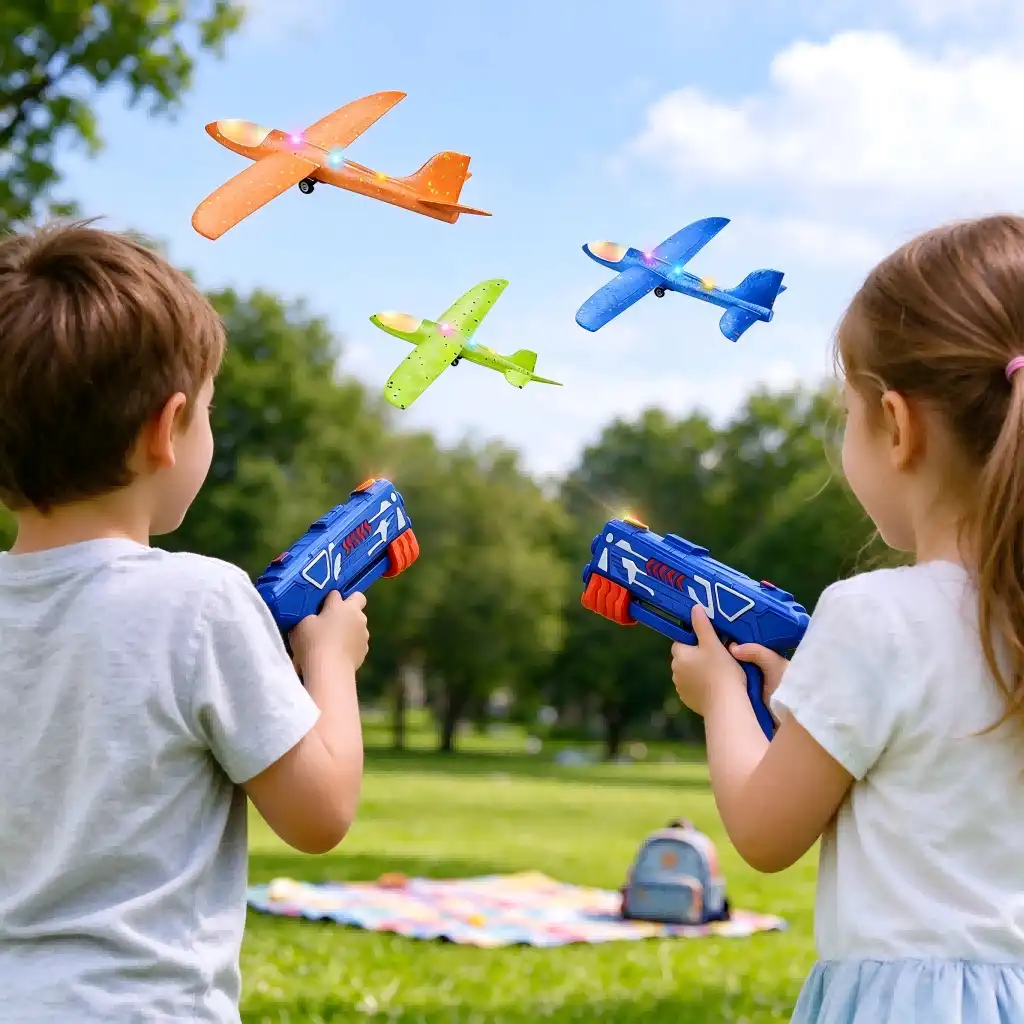
Statista (2024) says that the US toy market was worth $40.1 billion in 2023. Toys that can be used outside are always a popular choice for holiday gifts. Airplane launcher toys can be used for both birthday and Christmas gift boxes because they are reasonably priced.
These are the steps that experienced buyers take when they want to buy big glider launcher sets:
- Request factory in-stock inventory lists to identify ready-to-ship SKUs that can fulfill reorder cycles within 2–4 weeks, avoiding seasonal stockouts.
- Negotiate tiered volume pricing at 500, 1,000, and 5,000 unit levels to protect your wholesale margin as the product proves itself in your channel.
- Verify certifications before sampling — specifically ASTM F963 for the US market, EN71 for Europe, and UKCA for the UK — so compliance issues surface before tooling costs are committed.
- Evaluate after-sales policies including missing-part replacement and damage claim procedures, because even low defect rates at scale translate to meaningful customer service workload.
- Get lists of what the factory has in stock to find SKUs that are ready to ship and can meet reorder cycles in two to four weeks. This way, you won't run out of stock when you need it most.
- To protect your wholesale profit while the product shows up in your channel, set different prices for 500, 1,000, and 5,000 units.
Before you buy tools, make sure they meet the standards (ASTM F963 for the US market, EN71 for Europe, and UKCA for the UK). This will help you find compliance issues before you spend money on tools.- Look at the rules that come after the sale, like how to make a damage claim or fix a missing part. This is important because even if the failure rate is low, it still means a lot of work for customer service.
FAQs
Why does the glider nose-dive immediately after launch?
A nose-dive usually points to center-of-gravity misalignment or a launch angle below 15 degrees. Make sure the glider sits fully in the guide rail before releasing the trigger.
Are EPP foam gliders replaceable if one breaks?
Yes. Professional-grade launcher systems use universal rail designs that accept multiple glider models, as long as the replacement glider meets the weight-to-thrust ratio for that spring tension setting.
What is the recommended age range for this product?
This specific product is rated for children aged 36 months to 12 years. Units with stronger spring tensions are typically graded for ages 6 and above due to trigger activation force requirements.
Can these toys handle outdoor wind conditions?
Performance stays consistent in winds up to roughly 10 mph. Above that threshold, flight trajectory becomes unpredictable. Launching directly into the wind improves lift stability.
What certifications should buyers require?
For the US market, ASTM F963 and CPSIA compliance are non-negotiable. European and UK buyers need EN71 and CE/UKCA documentation. Chemical compliance covering REACH, lead, and phthalate testing is required for all major markets.
Ready to Source Airplane Launcher Toys? Contact Kingwe-star Today
Since 2009, Kingwe-star has made and sold toys and gifts for kids. They have CE, EN71, ASTM F963, CPSIA, and BSCI certifications from more than 100 foreign countries. We are a low-MOQ trial order airplane rocket toys seller team, and we can send you a sample in as little as three days. This item comes in full OEM packing and has a three-year guarantee. You can email luna@bllgift.com or visit bllgift.com to get a list of companies that make airplane rocket toys and get prices for the next holiday shopping season.
Conclusion
As a spring engineer, you need to know a lot about how to make good airplane launcher toys. You also need to know how to make a good EPP foam glider, use certified-safe materials, and do a full multi-stage inspection. For bulk buyers and gift-channel importers, the fastest way to find suppliers who can meet their needs and avoid costly compliance problems is to understand how the goods are made. This little thing, which is 13.5 by 8 by 2.2 inches and weighs only 9.6 ounces, fits nicely into birthday and holiday gift sets for kids 36 months to 12 years old. The best and safest way to get a successful SKU is to buy from a plant that has low order minimums and certifications that can be checked.
References
- Consumer Product Safety Commission (CPSC). ASTM F963 Toy Safety Standard. 2023.
- European Committee for Standardization. EN 71 Safety of Toys Standard. 2023.
- Statista Research Department. U.S. Toy Market Revenue Report. 2024.
- The Toy Association. U.S. Toy Industry Annual Report. 2023.
- ASTM International. Standard Consumer Safety Specification for Toy Safety (ASTM F963-23). 2023.
- European Chemicals Agency (ECHA). REACH Regulation: Restrictions on Hazardous Substances in Consumer Products. 2023.

_1779947320754.jpg)
_1779703014142.png)
_1779947741675.jpg)
_1779947370800.jpg)
_1779947509721.jpg)
_1779947411407.jpg)
_1779947208267.jpg)